
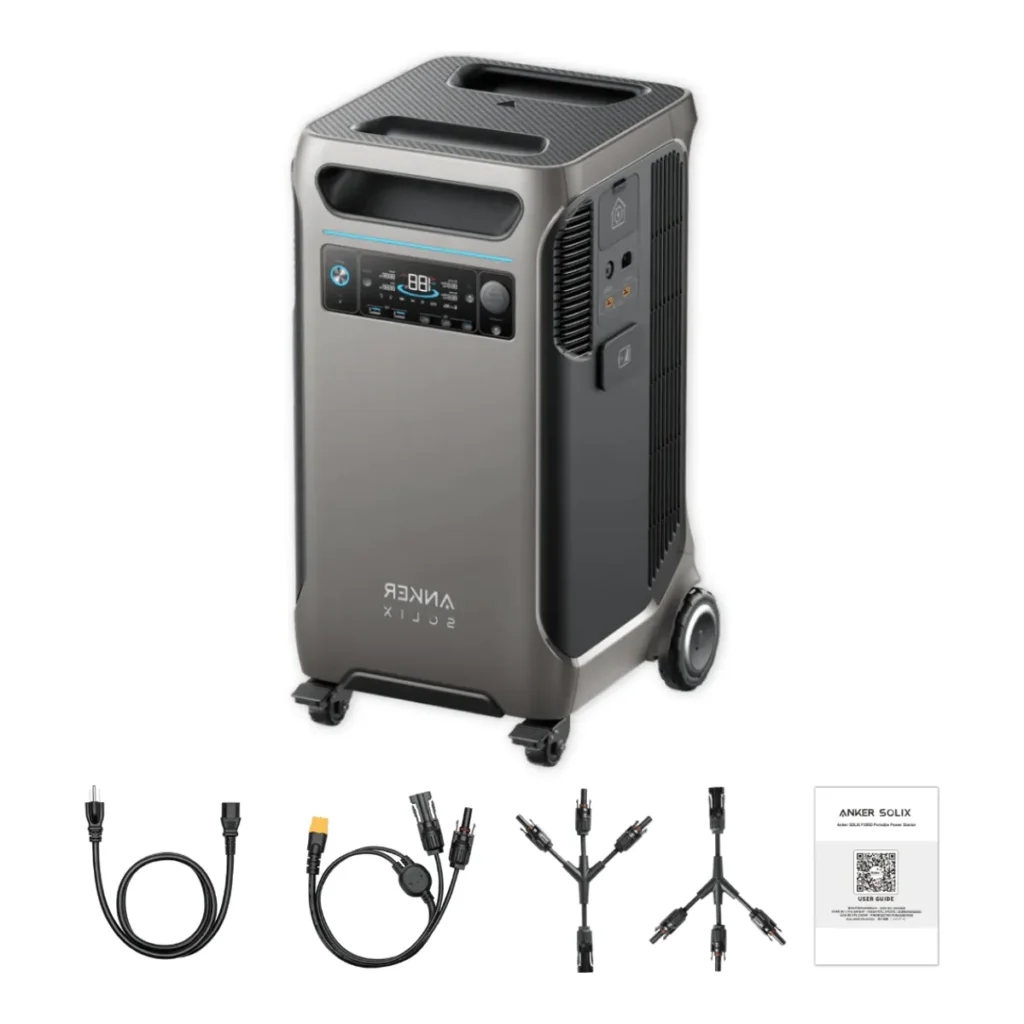
The Anker SOLIX F3800 and the EcoFlow DELTA Pro 3 are the two power stations most people shortlist when they want serious home backup without a permanent install. Both use LiFePO4 batteries, both deliver 120V and 240V, and both roll on wheels. The differences are in output, solar input and how each one grows into a bigger system.
Specs side by side
| Anker SOLIX F3800 | EcoFlow DELTA Pro 3 | |
|---|---|---|
| Battery capacity | 3,840Wh | 4,096Wh |
| Chemistry | LiFePO4 | LiFePO4 |
| Continuous AC output | 6,000W | 4,000W |
| Voltage | 120V / 240V | 120V / 240V |
| Solar input | Up to 2,400W | Up to 2,600W (dual PV) |
| Expansion | Up to 6 BP3800 batteries per unit | Extra batteries |
| Pairing two units | Double Power Hub, 12,000W | Parallel connection, up to 12,000W |
| UPS switchover | Not listed | 10ms |
| Manufacturer warranty | 5 years | 5 years |
Power output: F3800 wins
With 6,000W continuous, the F3800 has 50 percent more output than the DELTA Pro 3. That matters when several large loads run at once, for example a well pump, a furnace blower and a microwave. It also has NEMA 14-50 and L14-30 outlets, which makes it easy to connect an RV, an EV charger or a home inlet box.
The DELTA Pro 3’s 4,000W is still enough for most backup setups. EcoFlow rates it for a 3-ton central AC with a soft starter or a 1 HP well pump.
Capacity and solar: DELTA Pro 3 is slightly ahead
The DELTA Pro 3 stores a little more energy (4,096Wh vs 3,840Wh) and accepts a little more solar (2,600W vs 2,400W). In daily use the difference is small. On a sunny day both can refill most of their battery from solar alone.
UPS and everyday use: DELTA Pro 3
The DELTA Pro 3 switches to battery in 10 milliseconds, so it works as an uninterruptible power supply for computers, network gear or a home office. It is also designed to run quietly, which helps if it sits indoors.
Growing into home backup
Both can become a partial home backup system:
- Anker: add BP3800 expansion batteries, pair two F3800 units with the Double Power Hub for 12kW, or connect to Anker’s Smart Home Power Kit. See the F3800 + BP3800 bundle and the F3800 home backup bundle.
- EcoFlow: add extra batteries, connect two units in parallel, or pair it with Smart Home Panel 2. See the DELTA Pro 3 + extra batteries bundle and the DELTA Pro 3 + Smart Home Panel 2 kit.
For long outages, EcoFlow also offers the Smart Generator 4000 (Dual Fuel), which charges a DELTA Pro 3 at up to 3,200W DC and starts automatically when the battery runs low. It is not CARB-approved and cannot ship to California.
Which one should you buy?
Choose the Anker SOLIX F3800 if you need maximum output, plan to run several big 240V loads together, or want RV and EV-friendly outlets.
Choose the EcoFlow DELTA Pro 3 if you want UPS protection, slightly more capacity and solar input, or plan to add EcoFlow’s Smart Generator for extended outages.
Either way, if you want solar from day one, a kit is usually better value than buying parts separately. Browse our solar generator kits. Not sure how much capacity you need? Start with our home battery sizing guide.
Frequently asked questions
Can the F3800 or DELTA Pro 3 power a whole house?
One unit can cover essentials and some 240V loads. For a whole house, most people pair two units or move up to a dedicated whole home backup system.
Do they need to be installed?
They work as plug-in power stations out of the box. Connecting either one to your home’s circuits through a transfer switch or smart panel should be done by a licensed electrician.
Which lasts longer?
Both use LiFePO4 cells, which are known for long cycle life, and both carry a 5-year manufacturer warranty.
Shop the Anker SOLIX F3800 or the EcoFlow DELTA Pro 3, both with free US shipping and free 30-day returns.