
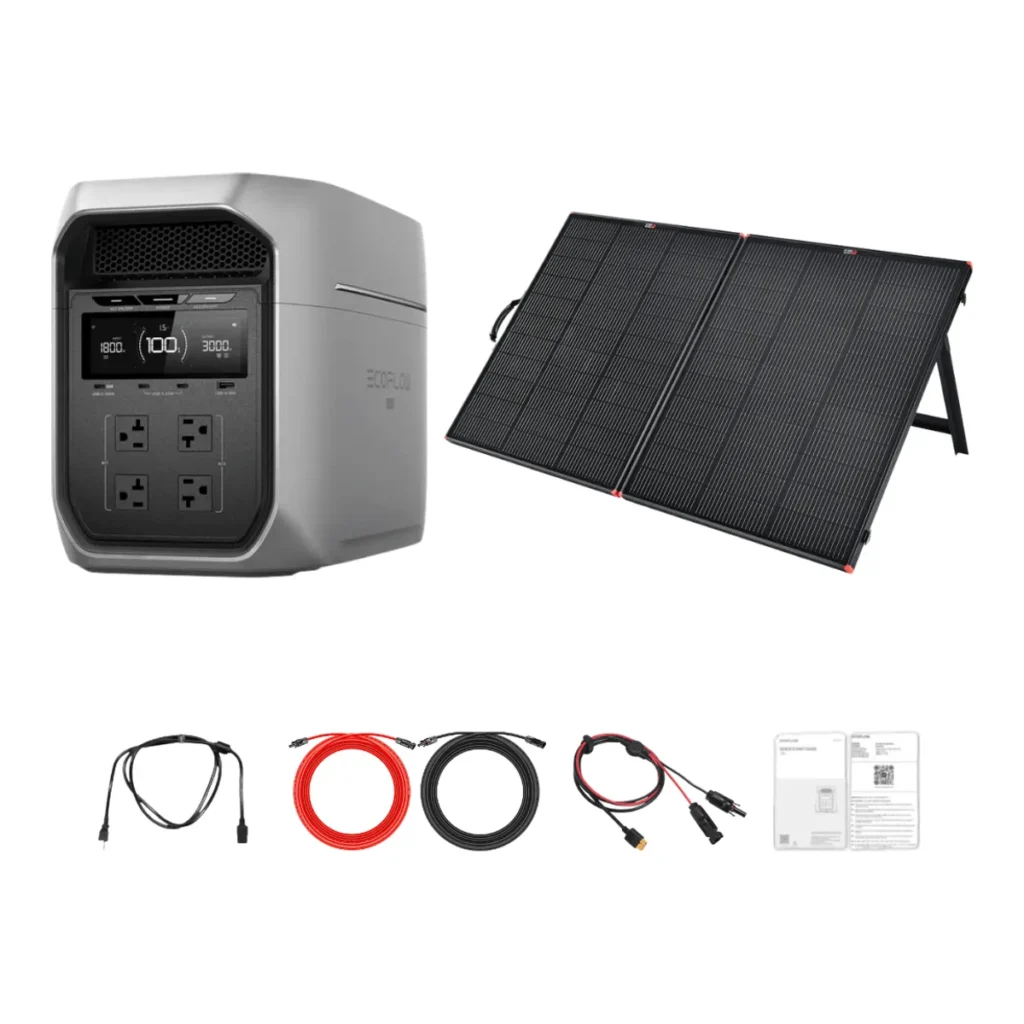
When the power goes out, a generator keeps your fridge cold and your lights on. But “generator” now means two very different things: a gas generator that burns fuel, or a solar generator, which is a battery power station recharged by solar panels. Here is how they compare and how to decide.
What is a solar generator?
A solar generator is a portable power station (battery plus inverter) paired with solar panels. It stores energy and releases it silently, with no fuel and no exhaust. Typical examples are the EcoFlow DELTA 3 Max Plus Solar Generator Kit and the Anker SOLIX F3000 Solar Generator with 400W panels.
Head to head
| Solar generator | Gas generator | |
|---|---|---|
| Fuel | Sunlight or grid power | Gasoline, propane or natural gas |
| Noise | Near silent | Loud |
| Indoor use | Yes | Never (carbon monoxide risk) |
| Running cost | Close to zero | Fuel and regular maintenance |
| Upfront cost per watt | Higher | Lower |
| Run time | Limited by battery and sun | As long as fuel lasts |
| Maintenance | Minimal | Oil changes, fuel stabilizer, test runs |
| Instant switchover | Yes, on many models | No, must be started |
Where solar generators win
- Safety: no fumes, so they can sit inside your home or garage.
- Silence: no engine noise for you or your neighbors.
- No fuel runs: no storing gasoline, no lines at the gas station after a storm.
- Everyday value: use it for camping, RV trips and job sites, or to shift power use to off-peak hours.
Where gas generators win
- Long outages: as long as you have fuel, they keep running, even through a week of cloudy weather.
- Lower upfront cost for the same peak output.
The best of both: battery plus smart generator
A growing number of systems combine the two. The battery handles everyday outages silently, and a fuel generator starts automatically only when the battery runs low.
- The EcoFlow Smart Generator 4000 (Dual Fuel) recharges a DELTA Pro 3 at up to 3,200W DC on gasoline or propane, and EcoFlow says it uses up to 40 percent less fuel to fully charge a DELTA Pro 3 than a conventional generator.
- The Anker SOLIX Smart Generator 5500 runs on gasoline, propane or natural gas and recharges the Anker SOLIX E10 home backup system automatically.
Note: both smart generators are not CARB-approved and cannot be shipped to California.
Which one should you choose?
Choose a solar generator if outages in your area are usually short, you want to run it indoors, or you want something you can also take camping. Start with our solar generator kits.
Add a smart generator if you get multi-day outages, especially in winter when solar output is low. See our smart generators.
Go whole home if you want the entire house covered. See whole home backup systems, and use our sizing guide to pick the right capacity.
Frequently asked questions
How long can a solar generator run a refrigerator?
A typical fridge uses 1 to 2kWh per day. A 2kWh power station can run it for roughly a day, and a 4kWh unit for about two days, longer with solar recharging.
Can a solar generator charge on cloudy days?
Yes, but much more slowly. That is why many people keep the option of charging from the grid, a car or a smart generator.
Is a solar generator worth it?
If you value silent, fume-free power that you can use indoors and take on trips, yes. For very long outages, pair it with a fuel generator.
Need help choosing? Email support@frozena.shop. Free US shipping and free 30-day returns on every order.