
The inverter is the heart of any solar and battery system. It turns DC power from panels and batteries into the AC power your home uses, and it decides how your system behaves when the grid goes down. The first choice you have to make is simple: hybrid or off-grid?
What an off-grid inverter does
An off-grid inverter (often called an inverter charger or all-in-one) runs your loads from solar and batteries. It can usually charge batteries from the grid or a generator, but it does not send power back to the utility.
Best for: cabins, workshops, RV pads, rural homes without a grid connection, and backup systems where you never plan to export power.
Example: the EG4 6000XP delivers 6,000W of 120/240V split phase output, accepts 8,000W of solar at up to 480VOC, includes a 140A battery charger and can run up to 16 units in parallel.
What a hybrid inverter does
A hybrid inverter does everything an off-grid inverter does, and it can also work with the grid: it can export excess solar (where your utility allows it), use time-of-use settings to save money, and switch to battery when the grid fails.
Best for: grid-connected homes that want lower bills and backup power from the same system.
Examples:
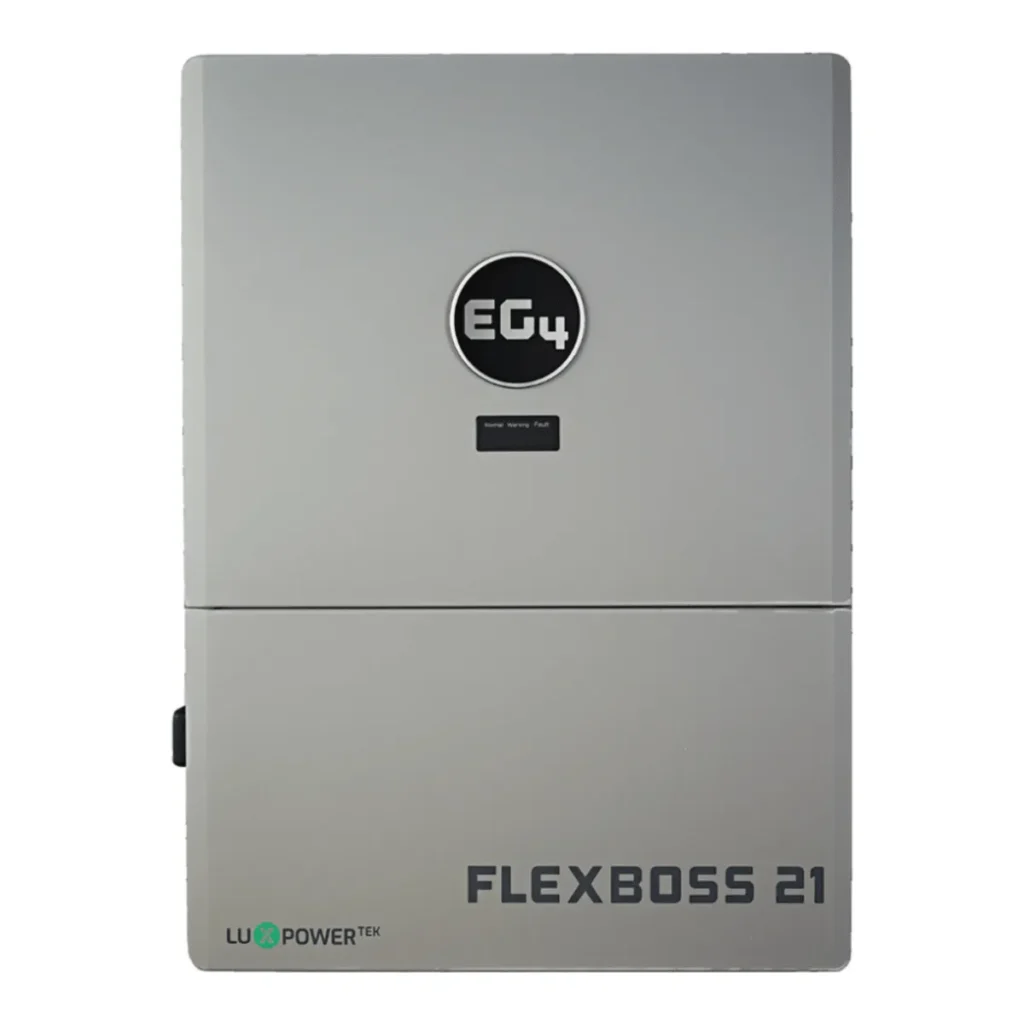
- EG4 FlexBOSS21: 16kW continuous output, 21kW of PV input on three MPPTs, UL 1741 and CEC listed.
- Sol-Ark 15K-2P: a pre-wired all-in-one unit with grid-tie, off-grid and backup modes, time-of-use settings and both DC and AC coupling.
Hybrid vs off-grid at a glance
| Off-grid inverter | Hybrid inverter | |
|---|---|---|
| Runs loads from solar and battery | Yes | Yes |
| Charges from grid or generator | Yes | Yes |
| Exports power to the grid | No | Yes (utility approval needed) |
| Time-of-use bill savings | Limited | Yes |
| Typical cost | Lower | Higher |
| Permitting | Usually simpler | Interconnection approval needed |
How to size your inverter
- Continuous output: add the running watts of everything that can run at the same time, then add about 25 percent headroom.
- Surge: make sure the inverter can start your largest motor (well pump, AC compressor) while other loads are running.
- Solar input: match the inverter’s PV input and maximum voltage to your panel array.
- Split phase: US homes with 240V appliances need 120/240V split phase output.
Not sure how much power you need? Read our guide on how to size a home battery backup system.
12V, 24V or 48V?
Higher battery voltage means lower current, thinner cables and better efficiency. As a rule of thumb:
- 12V: vans, small RVs and boats, up to about 2,000 to 3,000W.
- 24V: larger RVs, cabins and small off-grid systems, up to about 4,000 to 6,000W.
- 48V: homes and anything above about 5,000W. Almost all whole home inverters are 48V.
Shop 12V and 24V LiFePO4 batteries for mobile systems, or 48V home energy storage batteries for house-sized builds.
Our recommendation
If your home is connected to the grid and you want to cut bills as well as keep the lights on, choose a hybrid inverter. If you live off the grid, or only want backup and never plan to export, an off-grid inverter does the job for less money.
Compare every model in our solar inverters collection.
Frequently asked questions
Can a hybrid inverter work without batteries?
Many hybrid inverters can run grid-tied with solar only, but you lose backup power during an outage. Check the specific model’s documentation.
Can I use an off-grid inverter in a grid-connected home?
Yes, as long as it does not export to the grid. It can charge from the grid and power selected circuits through a subpanel. Installation should follow local code.
Do I need a permit?
Most areas require a permit for any system wired into your home, and grid-tied systems also need approval from the utility. Work with a licensed electrician or solar installer.
Questions about compatibility? Email support@frozena.shop. All inverters ship free in the US with free 30-day returns.